Calorie Deficit Calculator: How to Estimate Calories for Weight Loss
A calorie deficit occurs when your body uses more energy than you consume from food and drinks. It is one of the basic principles behind weight loss, but figuring out an appropriate calorie target is not as simple as subtracting a fixed number from your daily intake.
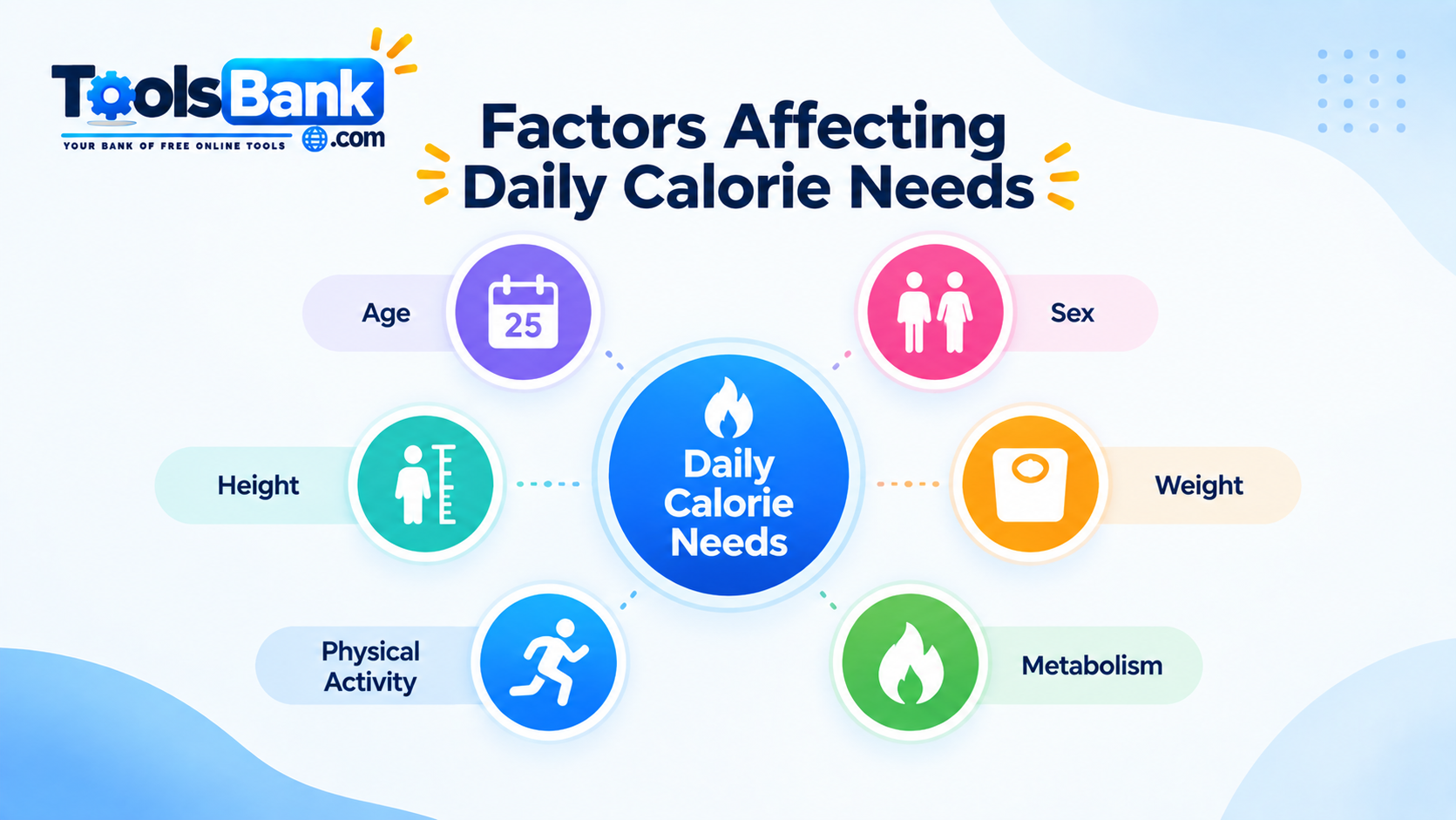
Your calorie needs depend on several factors, including your age, sex, height, weight, metabolism, and physical activity level.
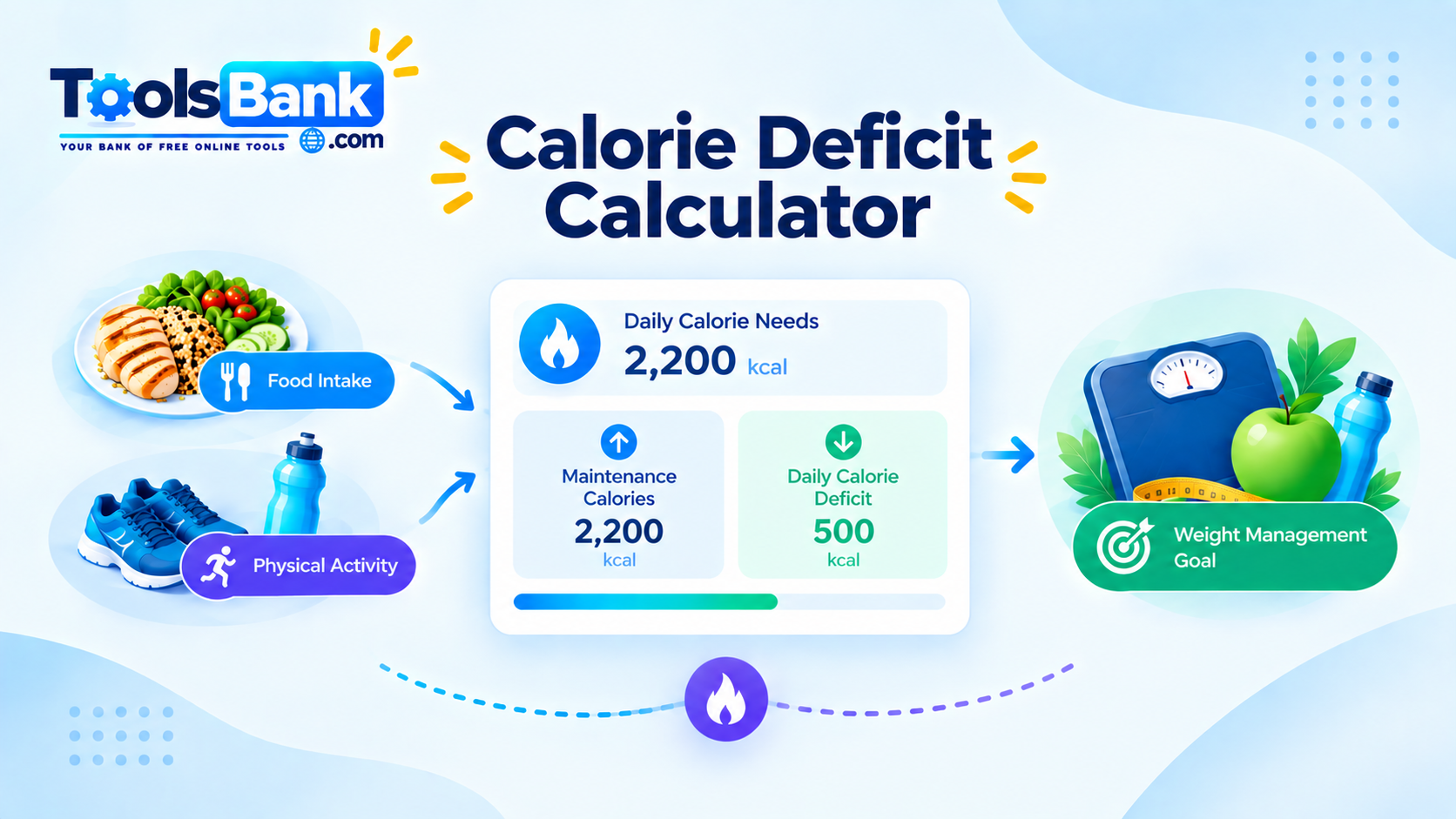
A calorie deficit calculator can help turn these factors into an estimated daily calorie target. It can be useful as a starting point for planning, but the result is an estimate rather than a guarantee of how much weight you will lose.
You can use the ToolsBank Calorie Deficit Calculator to estimate your calorie needs and explore a potential calorie deficit based on your information.
What Is a Calorie Deficit?
A calorie deficit means you are consuming fewer calories than your body uses over a period of time.
For example, if someone needs approximately 2,400 calories per day to maintain their current weight and consumes fewer calories than that, they may create an energy deficit.
A deficit can come from reducing calorie intake, increasing physical activity, or combining both approaches.
The important point is that the size of the deficit matters. A very aggressive restriction is not automatically better, and calorie requirements can change as body weight and activity change.
What Is a Calorie Deficit Calculator?
A calorie deficit calculator is an online tool that estimates how many calories you may need to consume to maintain your current weight and how a lower calorie intake could create a deficit.
Most calculators use information such as:
- Age
- Sex
- Height
- Current weight
- Activity level
- Desired rate of weight loss or calorie deficit
The exact inputs and calculation method can vary between calculators.
The ToolsBank Calorie Deficit Calculator is designed to make this calculation easier by allowing you to enter your information and receive an estimated calorie target.
How Does a Calorie Deficit Work?
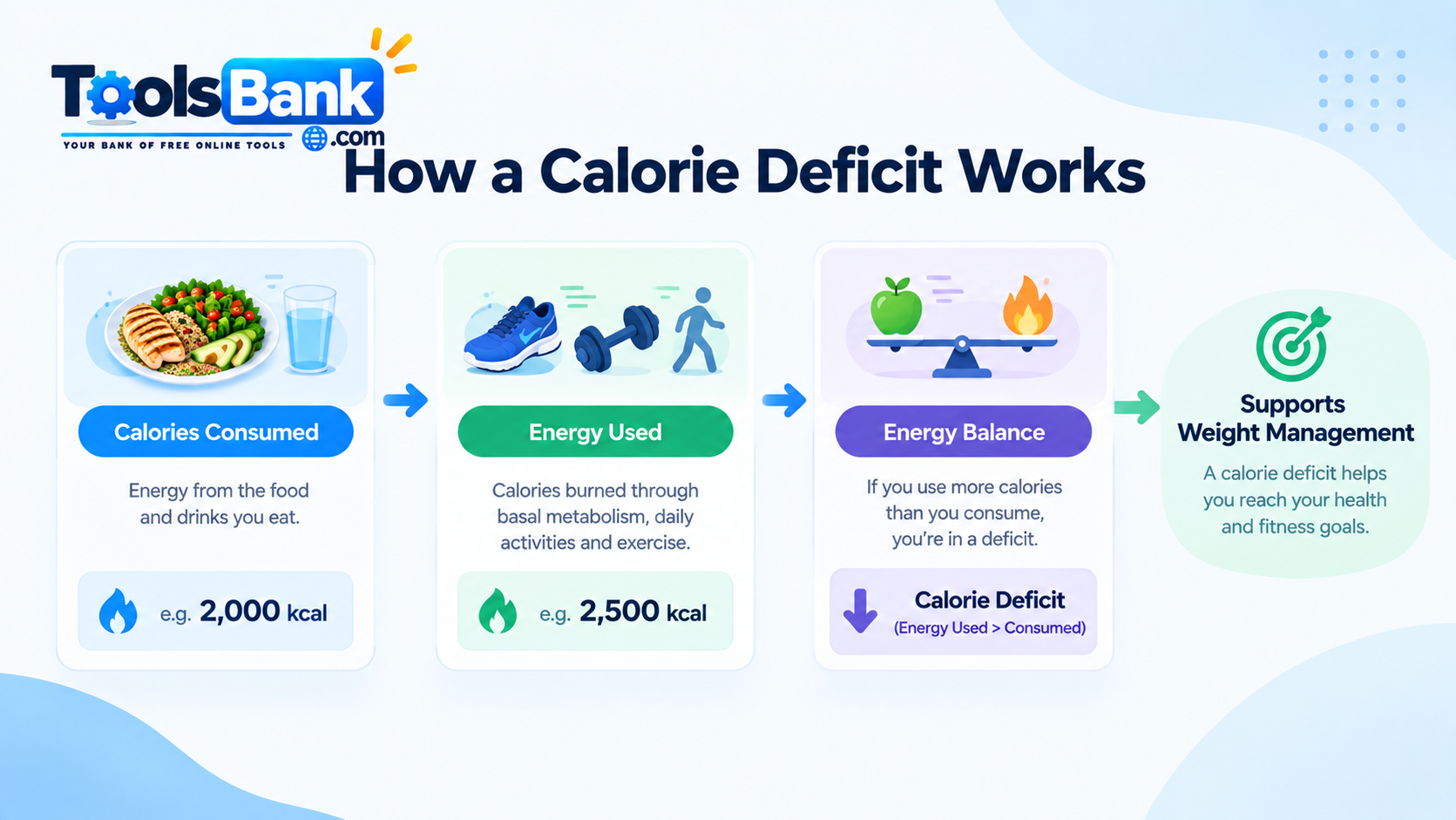
Your body requires energy throughout the day. Calories are used for basic physiological functions as well as movement and physical activity.
If energy intake and energy expenditure are roughly balanced over time, body weight may remain relatively stable. When energy expenditure exceeds energy intake, a calorie deficit occurs.
However, weight change is more complicated than a simple calorie equation. NIDDK's research explains that the body adapts to changes in calorie intake and body weight, which means simple fixed-calorie rules can overestimate long-term weight loss.
This is one reason a calorie calculator should be viewed as a planning estimate, not a precise prediction.
How Many Calories Should You Eat to Lose Weight?
There is no single calorie target that is appropriate for everyone.
Your energy needs depend on individual characteristics such as:
- Age
- Body size
- Sex
- Physical activity
- Metabolism
- Current weight
- Weight-management goals
NIDDK specifically notes that calorie requirements can differ based on age, weight, height, metabolism, sex, and activity level.
For this reason, copying another person's calorie target is not necessarily appropriate for you.
A calculator can provide a more individualized starting estimate by using your own information.
What Is a Reasonable Calorie Deficit?
There is no universal deficit that applies to every adult.
A commonly discussed starting point is a moderate reduction in daily calorie intake, but the appropriate amount depends on the person's circumstances and goals. MD Anderson notes that general recommendations sometimes use a 500-calorie-per-day reduction, while also emphasizing that calorie needs change as weight changes.
Older weight-loss guidance often used the idea that a 500-calorie daily deficit equals roughly one pound per week. That rule can be useful as a rough illustration, but it should not be treated as a precise long-term prediction. NIDDK's research explains why the body's changing energy requirements make the relationship more complicated.
A calculator therefore gives you an estimate, rather than promising a specific amount of weight loss.
How to Calculate a Calorie Deficit
The basic concept is:
Calorie deficit = calories used − calories consumed
For example, if your estimated daily energy expenditure were 2,300 calories and you consumed 2,000 calories, the difference would be:
2,300 − 2,000 = 300 calories
That represents an estimated 300-calorie daily deficit.
Over time, however, actual weight change will not necessarily follow a simple mathematical projection because energy expenditure and body weight can change during weight loss.
What Is Maintenance Calories?
Maintenance calories are an estimate of how many calories you need to maintain your current body weight under your usual activity conditions.
If your maintenance requirement were estimated at 2,300 calories per day, eating around that level might maintain your weight over time, although actual requirements vary.
A calorie deficit is created when your average intake falls below your energy needs.
Understanding maintenance calories is therefore an important part of understanding a calorie deficit.
How Activity Level Affects Calorie Needs
Physical activity contributes to your overall energy expenditure.
Someone who spends most of the day sitting may have different calorie requirements from someone who regularly walks, exercises, plays sports, or performs physically demanding work.
This is why calorie calculators commonly ask about activity level.
NIDDK explains that calorie needs can vary substantially with physical activity.
However, activity should not be viewed only as a way to "earn" food. Regular physical activity has broader health benefits and can help support weight management.
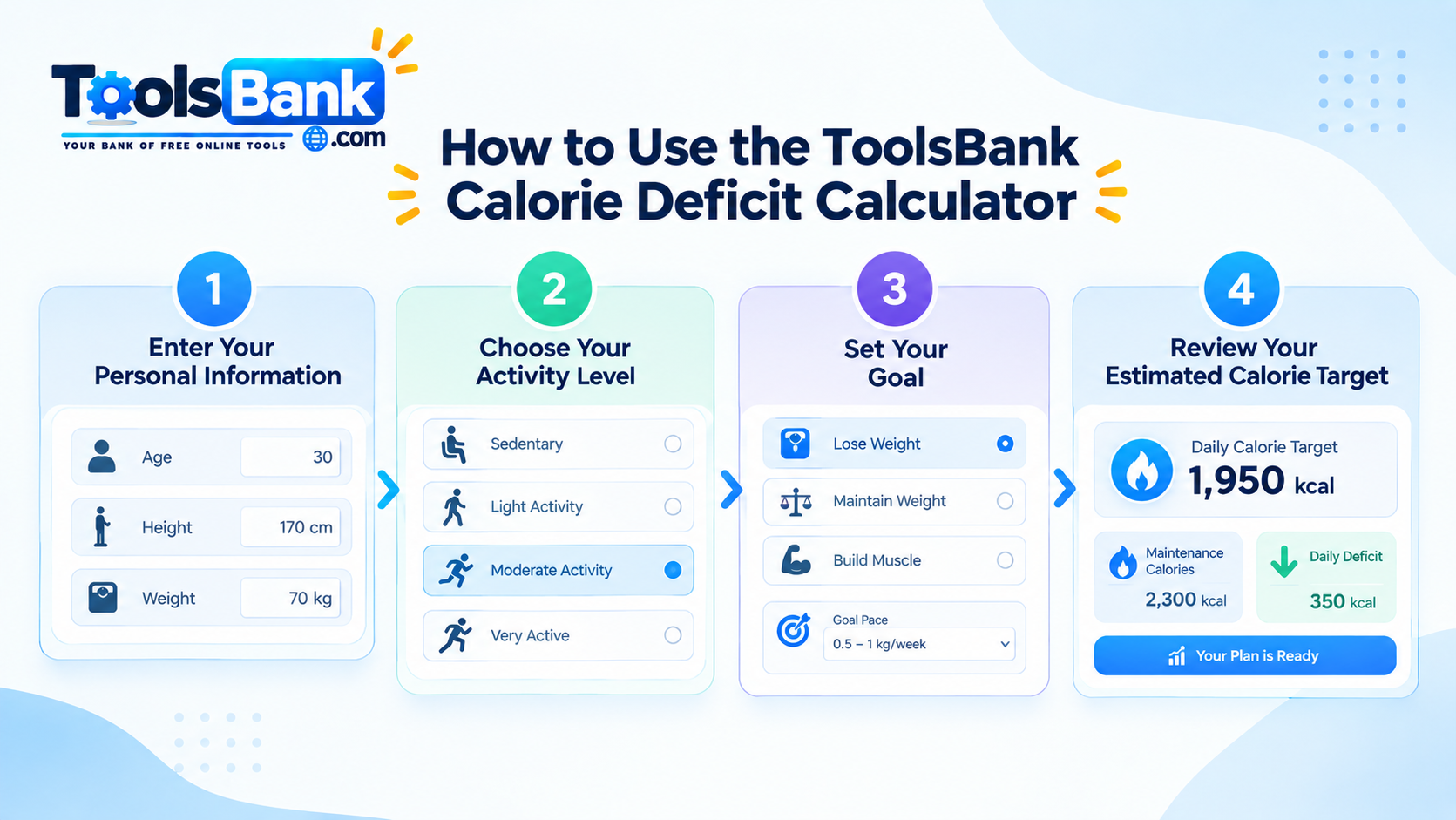
How to Use the ToolsBank Calorie Deficit Calculator
You can use the ToolsBank Calorie Deficit Calculator as a starting point for estimating your calorie needs.
Step 1: Enter your personal information
Enter the requested information, such as your age, sex, height, and current weight.
Accurate inputs generally produce a more useful estimate.
Step 2: Select your activity level
Choose the activity level that most closely represents your normal routine.
Try to describe your usual activity rather than selecting an unusually active week.
Step 3: Enter your weight-loss goal
If the calculator asks for a desired rate or deficit, choose a realistic target rather than automatically selecting the largest available deficit.
Step 4: Review the estimated results
The calculator provides an estimated calorie target based on the information you entered.
Remember that this is an estimate. Your actual calorie requirements may differ.
Step 5: Use the result as a starting point
Monitor how your body responds over time rather than assuming the initial calculation will remain perfect indefinitely.
NIDDK's Body Weight Planner is designed around the idea that energy requirements change during weight loss, which is an important limitation of simple calorie calculations.
Why Your Calorie Target Can Change
Your calorie needs are not necessarily fixed forever.
As body weight changes, the amount of energy your body requires can also change. Changes in physical activity, body composition, and other factors can affect energy expenditure.
NIDDK research specifically describes metabolic and energy-expenditure adaptations that occur as body weight changes.
This means a calorie target calculated at the beginning of a weight-loss plan may eventually need to be reassessed.
That does not mean you should constantly change your calorie intake based on day-to-day fluctuations. Instead, look at longer-term trends and consider professional guidance when appropriate.
Does a Calorie Deficit Always Mean Weight Loss?
A sustained energy deficit is a fundamental part of losing body weight, but real-world weight change does not occur in a perfectly predictable straight line.
Body weight can fluctuate because of factors such as:
- Water retention
- Food volume
- Activity changes
- Hormonal changes
- Stress
- Sleep
- Changes in energy expenditure
CDC notes that factors including medications, medical conditions, stress, genes, hormones, environment, and age can influence weight management.
Therefore, a short-term change on the scale does not necessarily tell you whether a longer-term calorie deficit is working.
How Fast Should You Lose Weight?
CDC describes gradual weight loss of about 1 to 2 pounds per week as a commonly recommended pace for people who are trying to lose weight, noting that people who lose weight gradually and steadily are more likely to keep it off than those who lose weight more quickly.
That does not mean everyone should target exactly 1 to 2 pounds per week.
Your appropriate rate depends on your circumstances, and a healthcare professional can help determine a suitable goal if you have medical conditions, take medications, are pregnant or breastfeeding, or have other special nutritional needs.
Calorie Deficit vs. Calorie Restriction
These terms are related but not identical.
Calorie deficit describes an energy imbalance in which energy expenditure exceeds energy intake.
Calorie restriction generally refers to deliberately reducing calorie intake.
You can create a calorie deficit through a combination of eating fewer calories and increasing activity.
The goal should not simply be to eat as little as possible. A sustainable eating pattern should still provide adequate nutrition.
NIDDK recommends healthy eating patterns that include foods such as vegetables, fruits, whole grains, protein foods, and appropriate dairy or alternatives.
Common Calorie Deficit Mistakes
Setting an extremely large deficit
A larger deficit is not automatically a better strategy.
Very restrictive eating can make it harder to meet nutritional needs and maintain the approach over time.
Treating calculator results as exact
A calculator uses mathematical estimates. It cannot know every factor affecting your metabolism, appetite, activity, or health.
Use the result as a starting point rather than a guarantee.
Using someone else's calorie target
A calorie target that works for one person may be inappropriate for another because calorie needs vary considerably between individuals.
Ignoring nutrition quality
Calories are only one part of a healthy eating pattern.
The quality and variety of the foods you eat also matter. NIDDK recommends emphasizing nutrient-dense foods such as vegetables, fruits, whole grains, and healthy sources of protein.
Expecting the scale to change every day
Daily body weight can fluctuate even when longer-term progress is moving in the desired direction.
Looking at trends over time is generally more informative than focusing on one day's measurement.
Can You Create a Calorie Deficit Through Exercise?
Yes. Physical activity increases energy expenditure and can contribute to an overall calorie deficit.
However, weight management does not have to rely on exercise alone.
A calorie deficit can result from:
- Eating fewer calories
- Increasing physical activity
- Combining dietary changes with physical activity
NIDDK recommends both healthy eating and physical activity as part of weight management.
Physical activity also has benefits beyond calorie expenditure, so it should be considered part of an overall healthy lifestyle rather than simply a method for burning off food.
What If You Stop Losing Weight?
A period of slower progress does not necessarily mean that something has gone wrong.
As body weight changes, energy requirements can change as well. NIDDK's research shows that the body's response to weight loss is dynamic, which is one reason simple calorie calculations can become less accurate over time.
Other factors can also affect weight management, including stress, sleep, medications, medical conditions, and changes in activity.
If you are consistently struggling despite making changes, especially if you have symptoms or a medical condition, consider discussing the situation with a healthcare professional rather than continually cutting calories on your own.
Calorie Deficit Calculator: What the Result Does and Doesn't Tell You
A calculator can help estimate:
- Your approximate maintenance calorie needs
- A potential calorie deficit
- A starting calorie target
- How changes in activity may affect estimated calorie needs
But it cannot reliably tell you:
- Exactly how much weight you will lose
- Exactly how your metabolism will respond
- Whether a particular diet is medically appropriate for you
- Whether you have an underlying medical condition affecting your weight
- Whether your nutritional intake is adequate
For more personalized weight-management planning, NIDDK provides its own Body Weight Planner for adults. It also specifically states that the tool is not intended for younger people or for people who are pregnant or breastfeeding.
Final Takeaway
A calorie deficit is a useful concept for understanding weight loss, but calculating an appropriate calorie target requires more than applying one fixed formula.
Your age, sex, height, weight, activity level, and other factors all affect your estimated calorie needs. Your body's energy requirements can also change as your weight changes.
The ToolsBank Calorie Deficit Calculator can provide a convenient starting estimate based on the information you enter. Use the result as a planning aid rather than a guarantee of future weight loss.
For people who need individualized advice, particularly those with medical conditions or special nutritional needs, a qualified healthcare professional can provide guidance that a general calculator cannot.