

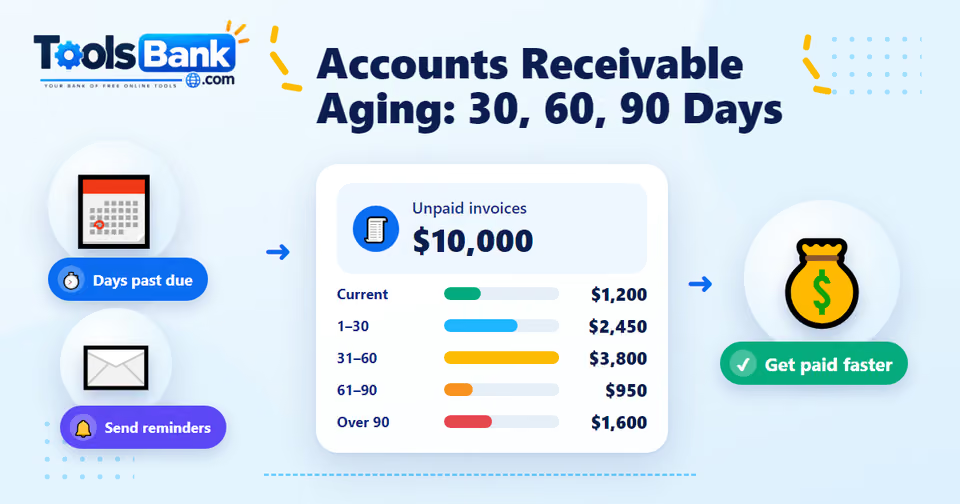
Accounts receivable aging means sorting your unpaid invoices by how long they are past their due date. The usual groups ("buckets") are current, 1–30, 31–60, 61–90 and over 90 days past due. To age an invoice, count the days from its due date to today. The older the bucket, the less likely the money is to come in, so the report tells you who to chase first.
Below is a worked example, the Excel formulas, and what to do at each stage. For a single invoice, the Date Difference Calculator gives the exact number of days.
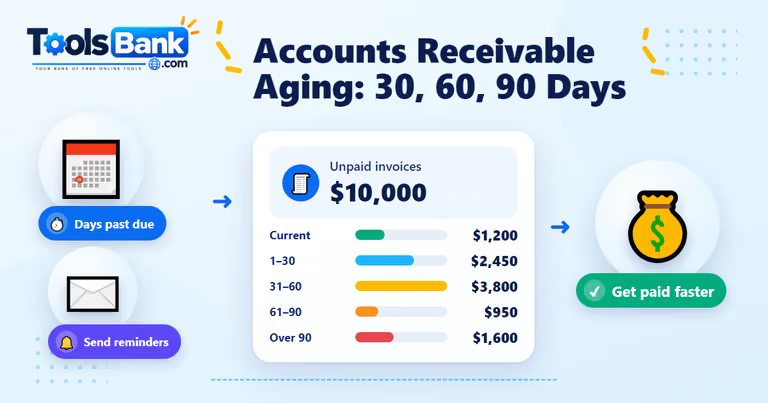
How to calculate days past due
1. Find the due date. Invoice date + payment terms. An invoice dated 20 September on Net 30 terms is due 20 October.
2. Count the days from the due date to today (or to your report date). From 20 October to 31 October is 11 days past due.
3. Put it in a bucket. 11 days goes in 1–30. If the due date hasn't arrived yet, the invoice is current.
To add terms to a date (for example, invoice date + 45 days), use the Date Calculator. If your terms count only working days, the Business Days Calculator skips weekends and holidays.
Due date or invoice date? Most aging reports count from the due date, which shows how late a customer really is. Some accounting software can also age from the invoice date. Pick one method and use it every month, so the reports are comparable.
Worked example: a $10,000 aging report
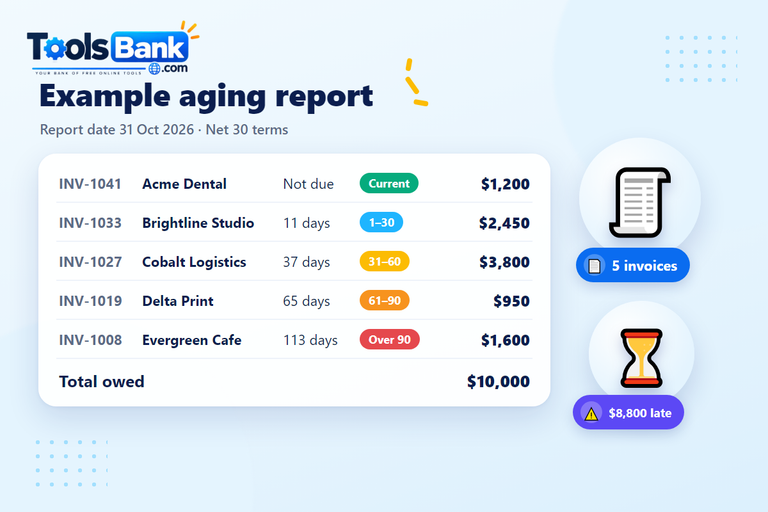
Report date 31 October 2026, all invoices on Net 30 terms:
| Invoice | Customer | Invoice date | Due date | Days past due | Bucket | Amount |
| INV-1041 | Acme Dental | 15 Oct 2026 | 14 Nov 2026 | Not yet due | Current | $1,200 |
| INV-1033 | Brightline Studio | 20 Sep 2026 | 20 Oct 2026 | 11 | 1–30 | $2,450 |
| INV-1027 | Cobalt Logistics | 25 Aug 2026 | 24 Sep 2026 | 37 | 31–60 | $3,800 |
| INV-1019 | Delta Print | 28 Jul 2026 | 27 Aug 2026 | 65 | 61–90 | $950 |
| INV-1008 | Evergreen Cafe | 10 Jun 2026 | 10 Jul 2026 | 113 | Over 90 | $1,600 |
Totals by bucket: current $1,200 · 1–30 $2,450 · 31–60 $3,800 · 61–90 $950 · over 90 $1,600, for $10,000 in total. So $8,800 (88%) of the money owed is already late, and $2,550 (25.5%) is more than 60 days late. To work out percentages like these, use the Percentage Calculator.
Excel or Google Sheets formulas
Put the report date in cell B1, the due dates in column C and the amounts in column E. Then:
•
Days past due (D2): =MAX(0, $B$1 -
C2) gives 0 for invoices that aren't due yet.
•
Bucket (F2):
=IF(B$1<=C2,"Current",IF(B$1-C2<=30,"1–30",IF(B$1-C2<=60,"31–60",IF(B$1-C2<=90,"61–90","Over
90"))))
•
Total per bucket: =SUMIF(F:F,"31–60",E:E),
and the same for each bucket.
Format column C as dates, not text, or the subtraction won't work. Copy the formulas down for every invoice, and change B1 each month.
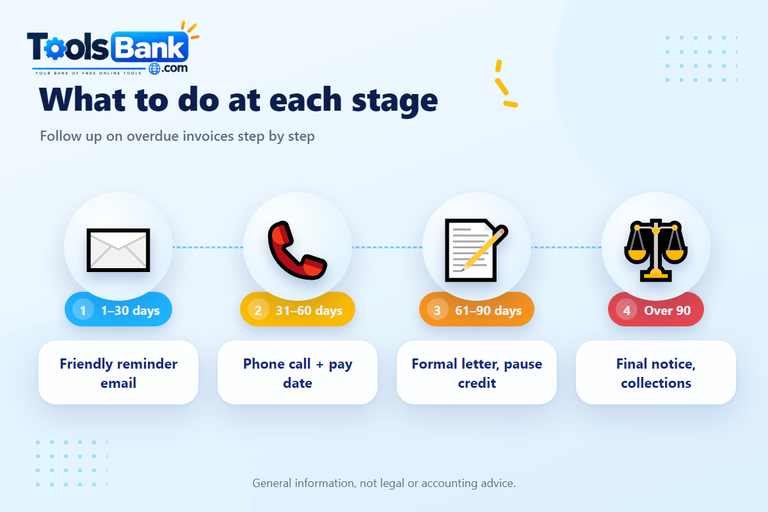
What to do at each stage
| Days past due | What usually works |
| 1–30 | A friendly reminder email with the invoice attached. Many late payments are simply forgotten. |
| 31–60 | A phone call or second email. Confirm the invoice was received and approved, and ask for a payment date. |
| 61–90 | A formal letter. Pause further work or deliveries on credit, and offer a payment plan. |
| Over 90 | Final notice. Consider a collection agency or small-claims court, and review whether the debt is still collectable. |
Two habits prevent most late payments: send invoices the day the work is done, and state the due date (not just "Net 30") on the invoice.
Estimating bad debt from the aging report
Businesses that use accrual accounting often estimate how much they won't collect by applying a percentage to each bucket. This is called the aging method for the allowance for doubtful accounts.
| Bucket | Amount | Example rate | Estimated uncollectable |
| Current | $1,200 | 1% | $12.00 |
| 1–30 | $2,450 | 5% | $122.50 |
| 31–60 | $3,800 | 15% | $570.00 |
| 61–90 | $950 | 30% | $285.00 |
| Over 90 | $1,600 | 50% | $800.00 |
| Total | $10,000 | $1,789.50 |
The rates above are only an example. Base yours on your own collection history, and ask your accountant how your business should record it.
Days sales outstanding (DSO)
DSO tells you how many days, on average, it takes to get paid: DSO = (accounts receivable ÷ credit sales) × number of days. With $48,000 owed and $180,000 of credit sales in the last 90 days: 48,000 ÷ 180,000 × 90 = 24 days. If your terms are Net 30 and DSO keeps rising above 30, customers are paying later over time.
This article is general information, not accounting, tax or legal advice.
Checking a single invoice? Enter the due date and today's date in the Date Difference Calculator to get the exact number of days past due.