


Short answer: at 25, a Roth IRA is usually the better pick. At 35 and 45 it depends on your tax bracket and whether you can deduct a Traditional IRA. At 55, many people split their money between both. The real rule behind all of this is simple: pay the tax when your tax rate is lowest.
Age is a useful shortcut because income, tax rates and years until retirement all change with it. Below is what usually works at each age, with 2026 figures, and you can test your own numbers in the Roth vs Traditional IRA Calculator.

The one rule that decides it
• Roth IRA: you pay tax now and get no deduction. Qualified withdrawals in retirement are tax-free.
• Traditional IRA: you may get a tax deduction now. Withdrawals in retirement are taxed as income.
• If your tax rate is lower now than it will be in retirement → Roth wins. If it's higher now → Traditional wins. If it's the same, they come out almost equal.
Your age matters because it predicts where you are on that curve: low income early in your career, peak income in your 40s and 50s, and usually lower income after you stop working.
Quick answer by age
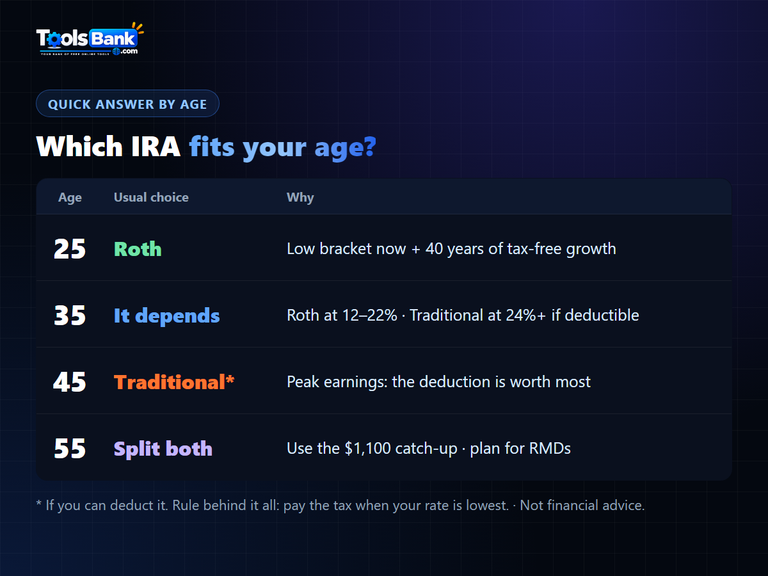
| Age | Usual choice | Main reason |
| 25 | Roth | Low tax bracket now and 40 years of tax-free growth |
| 35 | Roth if 12–22% bracket; Traditional if 24%+ and deductible | Income is rising; the deduction starts to be worth more |
| 45 | Traditional if deductible; otherwise Roth | Peak earning years make the deduction most valuable |
| 55 | Split between both | Shorter horizon; balance future taxes and RMDs |
At 25: a Roth IRA usually wins
Most people at 25 earn less than they will later. In 2026, a single filer stays in the 12% federal bracket up to $50,400 of taxable income, which is about $66,500 of salary after the $16,100 standard deduction. Paying 12% tax now to never pay tax on decades of growth is usually a good trade.
Example: $7,500 a year from 25 to 65 at a 7% average return grows to about $1.5 million. You put in $300,000; the other $1.2 million is growth, and in a Roth all of it comes out tax-free.
A Roth also doubles as a backup emergency fund: you can take out your contributions (not the earnings) at any time without tax or penalty. That flexibility matters most when you're young.
Exception: if you already earn a high salary at 25 and are in the 24% bracket or higher, read the 35 and 45 sections.
At 35: it depends on your bracket
By 35 many people earn more, and the answer splits:
• 12% or 22% bracket: Roth is still usually the better choice, or split your $7,500 between both.
• 24% bracket or higher: a Traditional IRA deduction saves you 24% or more now, which is often more than you'll pay in retirement.
• Covered by a workplace plan (401(k))? Your Traditional IRA deduction shrinks once your income passes $81,000 (single) or $129,000 (married filing jointly) and disappears at $91,000 / $149,000 in 2026. A Traditional IRA you can't deduct is usually worse than a Roth.
Example: $7,500 a year from 35 to 65 at 7% grows to about $708,000. Use the Paycheck Calculator to see your bracket, then compare both accounts in the Roth vs Traditional IRA Calculator.
At 45: Traditional if you can deduct it
Your 40s and 50s are often your highest-earning years, so this is when a Traditional IRA deduction is worth the most. If you're in the 24% bracket now and expect 12% or 22% in retirement, Traditional usually comes out ahead.
But many people at 45 can't use it, for two reasons:
• The deduction limit: if you have a 401(k) at work, the income limits above often remove the deduction.
• The Roth limit: direct Roth contributions phase out between $153,000 and $168,000 (single) or $242,000 and $252,000 (married filing jointly) in 2026.
If both limits apply to you, people often use a backdoor Roth: a non-deductible Traditional contribution that's then converted to a Roth. It's allowed, but the pro-rata rule can create a tax bill if you have other pre-tax IRA money, so check with a tax professional first.
Example: $7,500 a year from 45 to 65 at 7% grows to about $307,000.
At 55: split, and use the catch-up
From age 50 you can add a $1,100 catch-up, so the 2026 limit is $8,600. With 10 years to go, $8,600 a year at 7% grows to about $119,000.
At 55 your retirement tax rate is easier to predict, and two things favour putting at least part in a Roth:
• Required minimum distributions (RMDs): Traditional IRAs force withdrawals from age 73 (75 if you were born in 1960 or later), whether you need the money or not. Roth IRAs have no RMDs for the original owner.
• Heirs: a Roth left to your children is generally tax-free to them; a Traditional IRA is taxed when they withdraw it.
If you're still in a high bracket, the Traditional deduction remains valuable. That's why a split often works best at this age.
Is it too late to open a Roth at 55? No. Earnings are tax-free once you're 59½ and 5 tax years have passed since your first Roth contribution. Open one at 55 and that's met at 60.
2026 IRA limits and income caps
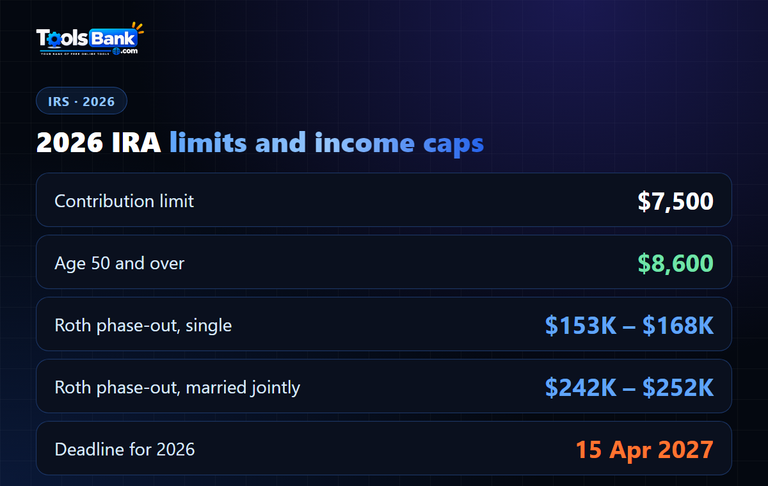
| 2026 figure | Amount |
| Contribution limit (all your IRAs combined) | $7,500 |
| Age 50 and over (with $1,100 catch-up) | $8,600 |
| Roth phase-out, single | $153,000 – $168,000 |
| Roth phase-out, married filing jointly | $242,000 – $252,000 |
| Traditional deduction phase-out, single with a workplace plan | $81,000 – $91,000 |
| Traditional deduction phase-out, married jointly, you have a workplace plan | $129,000 – $149,000 |
| Traditional deduction phase-out, only your spouse has a workplace plan | $242,000 – $252,000 |
| Deadline for 2026 contributions | 15 April 2027 |
Income here means modified adjusted gross income (MAGI). If nobody in your household has a workplace plan, a Traditional IRA is fully deductible at any income.
Not sure? Split it
You don't have to choose just one. You can put part of the $7,500 in a Roth and part in a Traditional IRA in the same year. Having both kinds of money in retirement lets you choose each year which one to withdraw from, which helps keep your tax bill down.
To see what your total savings could become, try the Retirement Savings Calculator or the Compound Interest Calculator.
This article is general education, not personal financial or tax advice. Figures are US federal rules for 2026; check the IRS pages below or ask a tax professional for your situation.
Ready to check your own numbers? Enter your current and expected retirement tax rates in the Roth vs Traditional IRA Calculator. It compares both accounts on the same out-of-pocket cost.
Sources: IRS: 401(k) and IRA limits for 2026 (IR-2025-111) · IRS: Roth IRAs · IRS: Required minimum distribution FAQs