

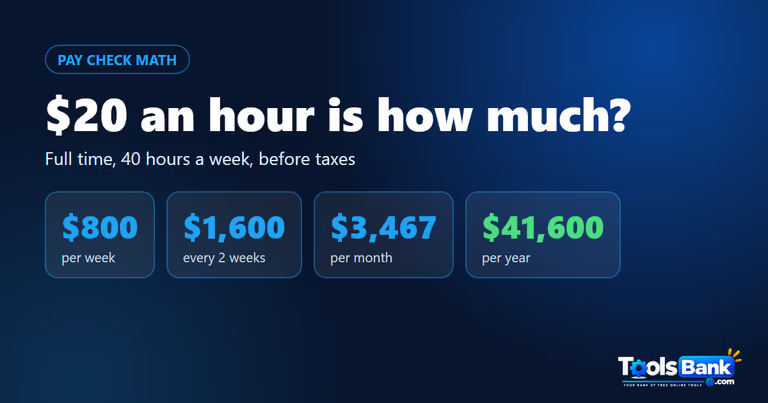
At $20 an hour and 40 hours a week, you earn $800 a week, $1,600 every two weeks and about $3,467 a month, which adds up to $41,600 a year before taxes.
Below you'll find the numbers for part-time hours, how overtime changes them, what a biweekly paycheck looks like after deductions, and the mistakes that make people's estimates wrong. To check a different rate or schedule, use the free Hourly to Salary Calculator.
$20 an hour at a glance (full time)
| Pay period | How it's calculated | Amount before taxes |
| Hourly | $20.00 | |
| Daily (8 hours) | 8 × $20 | $160 |
| Weekly (40 hours) | 40 × $20 | $800 |
| Biweekly (every 2 weeks) | 80 × $20 | $1,600 |
| Semimonthly (twice a month) | $41,600 ÷ 24 | $1,733.33 |
| Monthly | $41,600 ÷ 12 | $3,466.67 |
| Yearly | 2,080 × $20 | $41,600 |
The yearly figure uses 2,080 hours (40 hours × 52 weeks), the standard most payroll systems use. The calendar can differ a little: 2026 has 261 weekdays, or 2,088 hours, which would be $41,760 if you're paid for every one of them. Our post How Many Work Hours Are in 2026? shows the month-by-month breakdown.
Biweekly vs semimonthly: why the paychecks differ
"Biweekly" and "semimonthly" sound alike, but they're not the same schedule:
• Biweekly means every two weeks: 26 paychecks a year of $1,600 each.
• Semimonthly means twice a month, often on the 15th and the last day: 24 paychecks of about $1,733.33 each.
Both add up to the same $41,600. The difference is that biweekly workers get two months with three paychecks. Which months depends on your first payday. If you're paid every other Friday starting January 2, 2026, your three-paycheck months are January and July. If the first payday is January 9, they're May and October. Many people use that "extra" check for savings or bills.
Part-time pay at $20 an hour
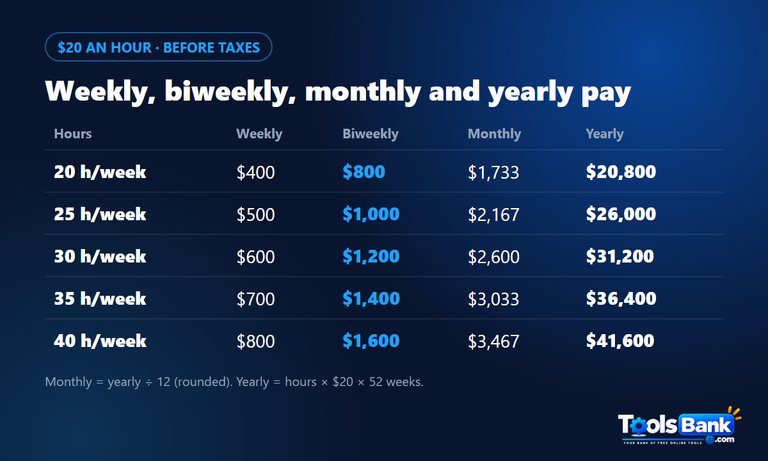
If your hours change from week to week, add up the actual hours instead of using a table. Minutes need converting first: 7 hours 45 minutes is 7.75 hours, not 7.45. The Time Duration Calculator does this for you, and our guide How to Calculate Hours Worked for Payroll explains the method.
Overtime at $20 an hour
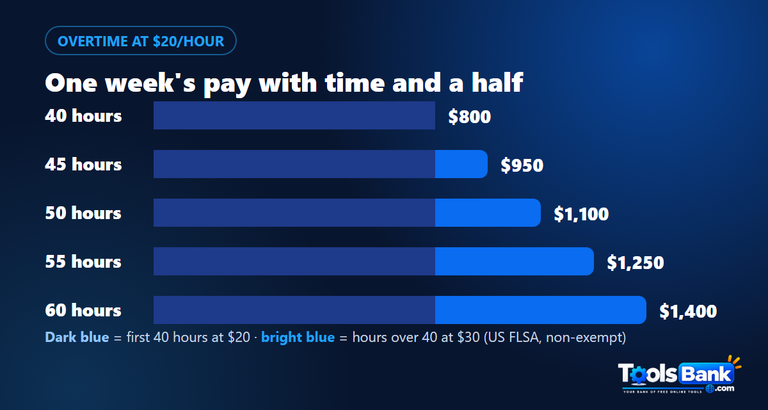
In the US, the Fair Labor Standards Act requires time and a half for hours worked over 40 in a workweek for non-exempt employees. At $20 an hour, overtime pays $30 an hour.
| Hours in the week | Regular pay | Overtime pay | Total for the week |
| 40 | $800 | $0 | $800 |
| 45 | $800 | 5 × $30 = $150 | $950 |
| 50 | $800 | 10 × $30 = $300 | $1,100 |
| 55 | $800 | 15 × $30 = $450 | $1,250 |
| 60 | $800 | 20 × $30 = $600 | $1,400 |
Two details catch people out:
• Each workweek stands alone. Working 50 hours one week and 30 the next is 10 hours of overtime, even though the two weeks average 40. Your employer can't average them across a biweekly pay period.
• Some states go further. California, for example, also requires overtime for long days, not just long weeks. Check your state's labor department if you work 10- or 12-hour shifts.
Salaried "exempt" employees usually aren't entitled to overtime, so these numbers apply to hourly, non-exempt jobs.
What you actually take home
Your gross pay isn't what lands in your bank account. Every US paycheck has Social Security (6.2%) and Medicare (1.45%) taken out, 7.65% together. On a $1,600 biweekly paycheck that's $122.40. Federal income tax depends on your W-4 and filing status, and state income tax depends on where you live (some states have none).
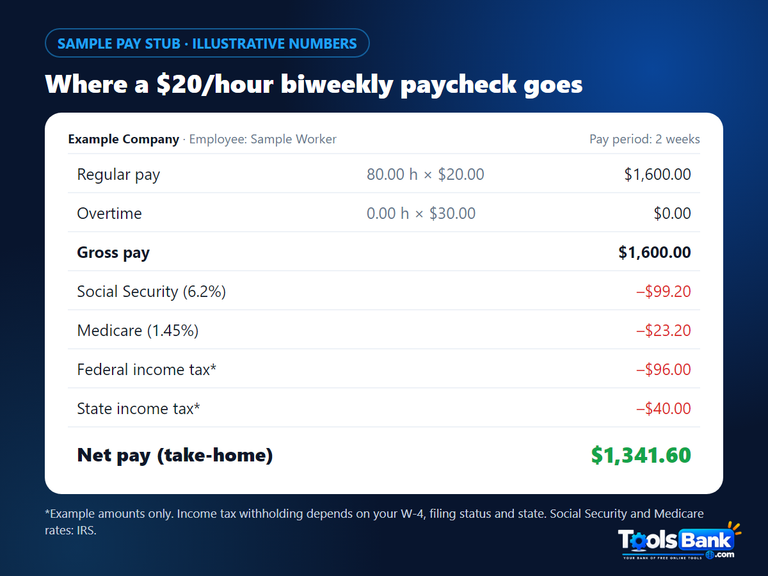
The sample stub above uses illustrative numbers to show where each line comes from. Your own withholding will be different. To estimate your real take-home pay, enter your hours and details in the Paycheck Calculator.
Common mistakes when estimating $20/hour pay
• Multiplying by 4 to get monthly pay. A month averages 4.33 weeks, not 4. "$800 × 4 = $3,200" undercounts by about $267 a month. Use yearly pay ÷ 12 instead.
• Forgetting unpaid time off. If you take two unpaid weeks a year, you work 2,000 hours, not 2,080, and earn $40,000 instead of $41,600.
• Averaging overtime over two weeks. Overtime is counted per workweek, so check each week separately.
• Comparing gross to net. A job offer is quoted before taxes. Compare offers using the same basis.
Want to check a different rate, or your exact hours? Try the Hourly to Salary Calculator and the Paycheck Calculator. Both are free and run in your browser.
This article uses US federal rules and a 40-hour week, and isn't tax or legal advice. State laws and employer policies can differ.
Sources: US Department of Labor, Overtime Pay · 29 CFR 778.104, each workweek stands alone · IRS Topic 751, Social Security and Medicare withholding rates