
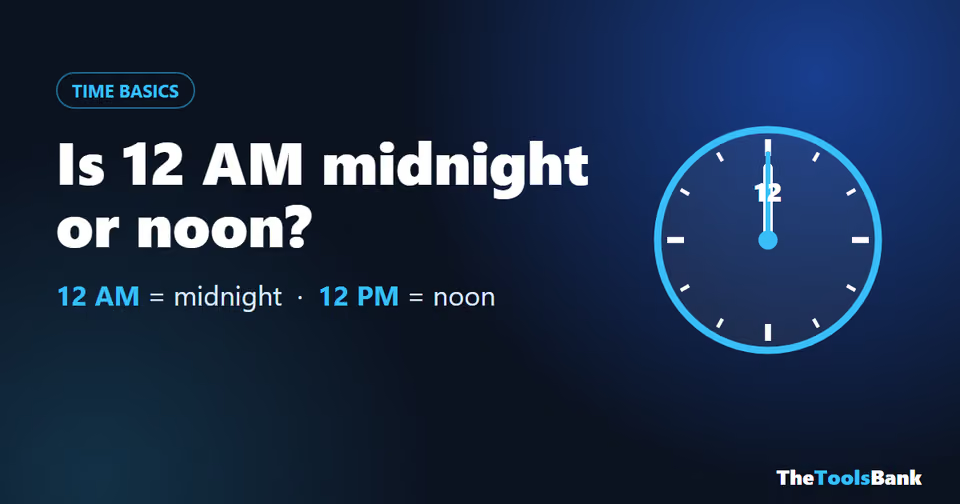
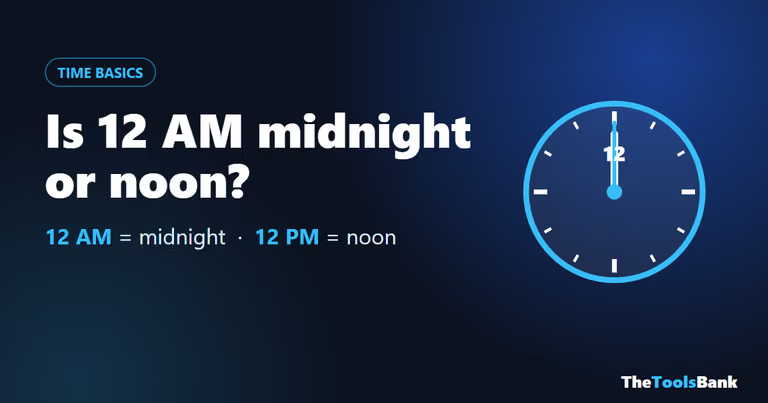
12 AM is midnight and 12 PM is noon. So "Friday at 12 AM" means the very start of Friday, the moment Thursday night ends, not Friday night. If that feels backwards, you're in good company: the US National Institute of Standards and Technology (NIST) calls 12 a.m. and 12 p.m. ambiguous and recommends not using them at all.
Below is the quick answer, why the labels trip people up, and a few simple ways to write times nobody can misread.
The quick answer
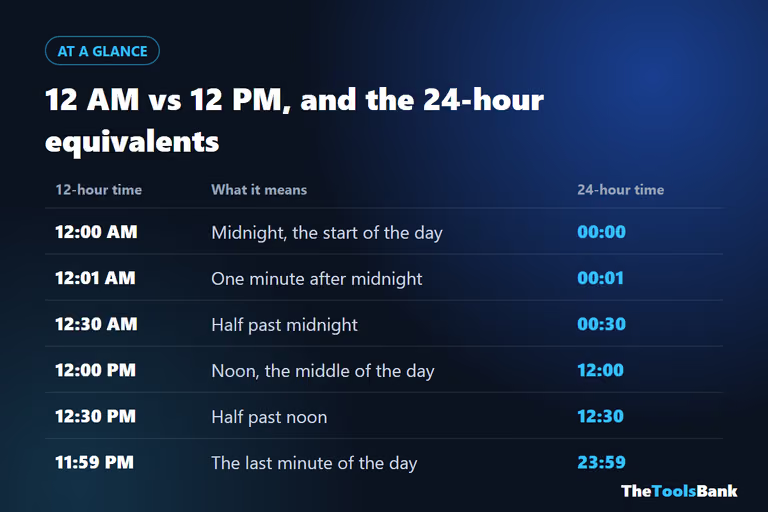
| 12-hour time | What it means | 24-hour time |
| 12:00 AM | Midnight, the start of the day | 00:00 |
| 12:30 AM | Half past midnight | 00:30 |
| 12:00 PM | Noon, the middle of the day | 12:00 |
| 12:30 PM | Half past noon | 12:30 |
| 11:59 PM | The last minute of the day | 23:59 |
Why 12 AM and 12 PM feel backwards
AM stands for ante meridiem, Latin for "before midday". PM is post meridiem, "after midday". Every other hour fits neatly: 11 AM is before noon and 1 PM is after it.
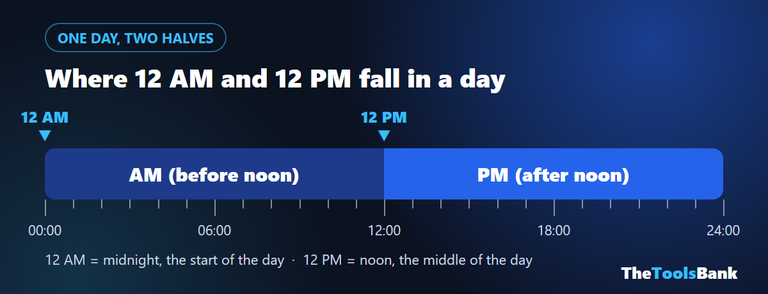
The problem is the two moments in between. Noon is neither before nor after noon, and midnight is exactly 12 hours away from noon in both directions. Neither label really fits either moment, which is exactly NIST's point. The convention most people use is that the clock switches to PM at noon and back to AM at midnight, so 12:00 PM is noon and 12:00 AM is midnight.
The number adds to the confusion. On a 12-hour clock, 12 comes before 1, so the order runs 11 AM, 12 PM, 1 PM. It looks as if 12 should belong to the morning, but it actually starts the afternoon.
Where the mix-ups actually happen
• Deadlines. "Due Friday at 12 AM" is technically the end of Thursday. Many people read it as Friday night and submit a day late.
• Travel bookings. A flight at 12:05 AM on the 15th leaves just after midnight at the start of the 15th, which is the night of the 14th. Travellers regularly arrive a day late for these.
• Opening hours. "Open until 12 AM" usually means until midnight tonight, but it's easy to read it the other way.
• Shift work and healthcare. Hospitals, airlines and the military avoid AM and PM entirely and use 24-hour time, because a 12-hour mistake there is costly.
How to write times nobody can misread
1. Write "noon" and "midnight" instead of 12 PM and 12 AM. This is what NIST recommends.
2. For deadlines, use 11:59 PM with the day, for example "Friday, 11:59 PM". Nobody reads that as the wrong night.
3. For start times just after midnight, use 12:01 AM and name the day, for example "12:01 AM Saturday".
4. Use 24-hour time when it really matters, for example 00:00 and 12:00. Our Military Time Converter turns any 12-hour time into 24-hour time and back.
5. Add the time zone for anything shared across regions, such as a webinar or a product launch.
Is midnight the start or the end of the day?
Midnight is the boundary between two days. In 24-hour time, 00:00 is the start of the new day. Some timetables write 24:00 to mean the end of a day, for example "open 08:00 to 24:00", which is the same moment as 00:00 the next morning.
The 12-hour clock has no equivalent, which is one more reason "12 AM" on its own causes trouble. If you're counting hours across midnight, such as a night shift from 10 PM to 6 AM, the Time Duration Calculator handles the date change for you.
Switch your phone to 24-hour time
If you often mix up 12 AM and 12 PM, the easiest fix is to let your phone show 24-hour time:
• iPhone: Settings → General → Date & Time → turn on 24-Hour Time.
• Android: Settings → System → Date & time → turn on Use 24-hour format. The exact wording varies by phone maker.
Need to convert a time? Use the free Military Time Converter. It shows any time in both 12-hour and 24-hour format, with no signup.
Source: NIST, Times of Day FAQs