
If you're eating less and the scale hasn't moved, the most likely explanation is that your deficit is smaller than you think, or that water weight is hiding the fat you've lost. Both are fixable. Below are the 8 most common reasons, how to check each one, and what to change.
Quick check: which one is it?
| Reason | How to check | What to do |
| Portions are bigger than you think | Weigh food for 3 days | Log weights, not "handfuls" |
| Drinks aren't logged | Write down every drink for a week | Count them, or switch to zero-calorie drinks |
| Weekends cancel the week | Compare weekday and weekend totals | Keep a weekend calorie limit |
| Water retention | Weight jumps after salty meals or new workouts | Use weekly averages, not daily weigh-ins |
| Your maintenance has dropped | You've lost 5–10 lb since you last calculated | Recalculate your target |
| Exercise calories are overestimated | You eat back what your watch says | Eat back half, or none |
| Not enough time has passed | Less than 3 weeks of data | Keep going and judge over 3–4 weeks |
| A medical cause | None of the above fits | Talk to your doctor |
1. Your portions are bigger than you think
This is the most common reason by far. Calorie-dense foods are easy to underestimate because a small change in size is a big change in calories. One tablespoon of cooking oil is about 120 calories. Two tablespoons of peanut butter are about 190. A "splash" of oil in the pan is often two or three tablespoons.
For three days, weigh everything with a kitchen scale and log the grams. You don't need to do this forever. A few days is usually enough to recalibrate your eye.
2. Drinks aren't in your log
Drinks add up quietly. A can of regular soda is around 140 calories. A medium glass of wine is about 120. A large milky coffee from a café can easily pass 200. Two or three of these a day can wipe out most of a 500-calorie deficit.
Log every drink for one week, including the milk in your tea. If the total surprises you, that's your answer.
3. The weekend cancels out the week
Say you run a 500-calorie deficit Monday to Friday. That's 2,500 calories for the week. If you eat 1,250 calories over maintenance on both Saturday and Sunday, you're back to zero. The week felt disciplined, but the scale has nothing to show for it.
Look at your weekly total, not just your weekdays. Setting a simple weekend limit, such as maintenance calories, protects most of your progress.
4. Water is hiding your fat loss
Your body weight swings by a kilo or more from day to day, and most of that swing is water. A salty dinner, a hard new workout, a high-carb day or the menstrual cycle can all make you hold extra water for several days. Fat loss continues underneath, but the scale doesn't show it yet.
Weigh yourself at the same time each morning, then compare weekly averages. If this week's average is lower than last week's, the deficit is working, even if Tuesday looked bad.
5. Your maintenance calories have dropped
A smaller body burns fewer calories. If you calculated your target at 200 lb and you're now 180 lb, the same daily intake gives you a smaller deficit than it did at the start. As a rough guide for a moderately active person, maintenance falls by about 300 calories over that 20 lb.
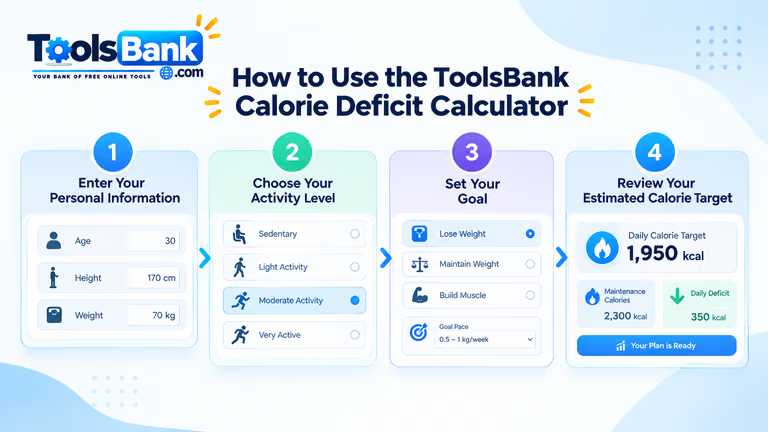
Recalculate your target every 5 to 10 lb with the Calorie Deficit Calculator. It takes a minute and often explains a stall on its own.
6. You're eating back exercise calories your watch overestimated
Fitness trackers are useful for steps and heart rate, but their calorie numbers are rough. A 2017 Stanford study tested seven wrist-worn devices and found that none of them measured calories burned accurately. If you eat back everything your watch reports, you may be eating back calories you never burned.
A safer habit: eat back half of the exercise calories, or treat them as a bonus and eat none. You can compare activities with the Calories Burned Calculator.
7. You haven't given it long enough
One or two weeks of data is mostly noise. Between water, digestion and the time of day you weigh in, short-term numbers can point the wrong way. Judge your progress over 3 to 4 weeks before changing anything.
8. Something medical is involved
If you've checked everything above and your weight still won't move, talk to your doctor. Some conditions, such as an underactive thyroid, and some medications can affect weight. This is not something to solve with a smaller calorie target.
When to recalculate your calorie target
Recalculate when you've lost 5–10 lb, when your activity changes (a new job, more training, an injury), or when your weekly average has been flat for 4 weeks even though your logging is accurate. Use the Calorie Deficit Calculator to get your new maintenance number and daily target.
Not as a first step. Check your logging, drinks and weekends first. A bigger deficit is harder to stick to, and it doesn't fix a counting problem.
This article is general information, not medical advice. If you have a health condition, or you're pregnant or breastfeeding, talk to a doctor or registered dietitian before changing how you eat.
Sources to link: NIH Body Weight Planner (NIDDK) · CDC "Losing Weight" · Stanford Medicine news on the 2017 fitness tracker accuracy study (Shcherbina et al., Journal of Personalized Medicine).