

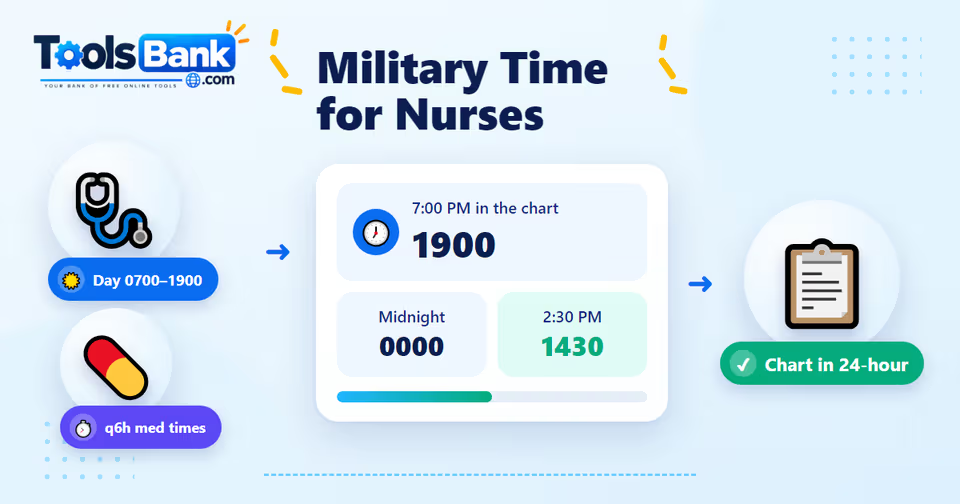
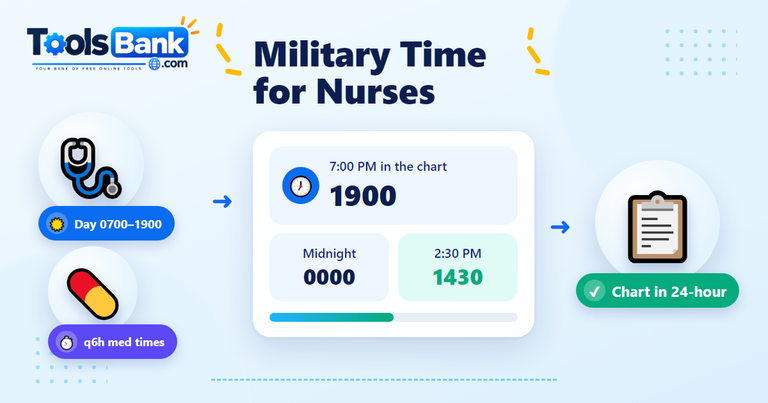
Most hospitals chart in military time (the 24-hour clock) because it removes the AM/PM mix-ups that cause medication and documentation errors. In nursing, 0700 is 7:00 AM, 1900 is 7:00 PM and midnight is usually written 0000. To convert any afternoon or evening time, add 12 to the hour: 2:30 PM becomes 1430.
Below are the charting rules, a chart for a full 24-hour day, example medication schedules and the mistakes to avoid. To convert a specific time, use the Military Time Converter.
The 5 rules for charting in military time
1. Always use four digits. Write 0830, not 830. The leading zero shows it's a time, not a number.
2. Don't add AM or PM. 1430 already means afternoon. "1430 PM" is wrong.
3. The colon is optional. Most charts write 1430; some electronic records show 14:30. Both mean 2:30 PM.
4. Midnight starts the day at 0000. 12:30 AM is 0030. Some facilities use 2400 for the end of a day (for example, a 24-hour intake total). Follow your facility's policy.
5. Say it as "hundred". 1500 is "fifteen hundred"; 0730 is "zero seven thirty". Saying it the same way at handoff avoids confusion.
Military time chart for a 24-hour shift
| Standard time | Military time | Standard time | Military time |
| 12:00 AM (midnight) | 0000 | 12:00 PM (noon) | 1200 |
| 1:00 AM | 0100 | 1:00 PM | 1300 |
| 3:00 AM | 0300 | 3:00 PM | 1500 |
| 6:00 AM | 0600 | 6:00 PM | 1800 |
| 7:00 AM | 0700 | 7:00 PM | 1900 |
| 8:30 AM | 0830 | 9:45 PM | 2145 |
| 11:00 AM | 1100 | 11:00 PM | 2300 |
| 11:59 AM | 1159 | 11:59 PM | 2359 |
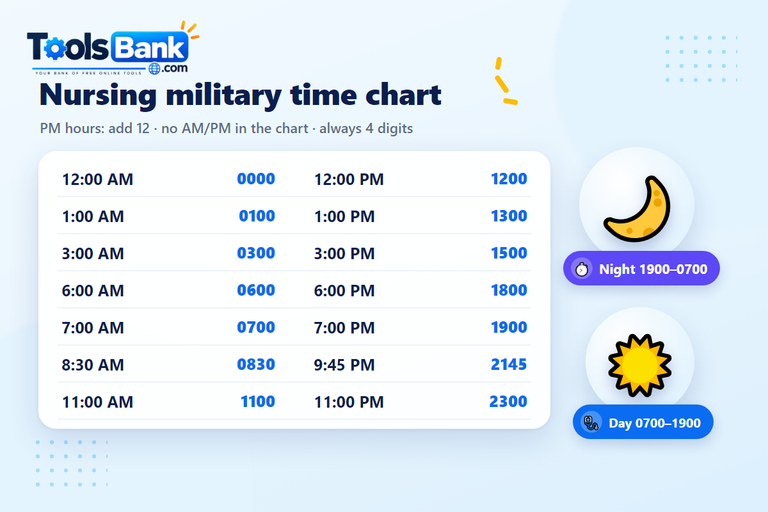
Two times cause most of the confusion: 12:00 AM is the start of the day (0000), and 12:00 PM is noon (1200). If you've ever mixed them up, see Is 12 AM Midnight or Noon?.
Common nursing shifts in military time
| Shift | Military time | Length |
| Day shift (12-hour) | 0700–1900 | 12 hours |
| Night shift (12-hour) | 1900–0700 | 12 hours |
| Day shift (8-hour) | 0700–1500 | 8 hours |
| Evening shift (8-hour) | 1500–2300 | 8 hours |
| Night shift (8-hour) | 2300–0700 | 8 hours |
For other shift lengths, with and without breaks, see the shift hours chart.
Medication schedules in military time
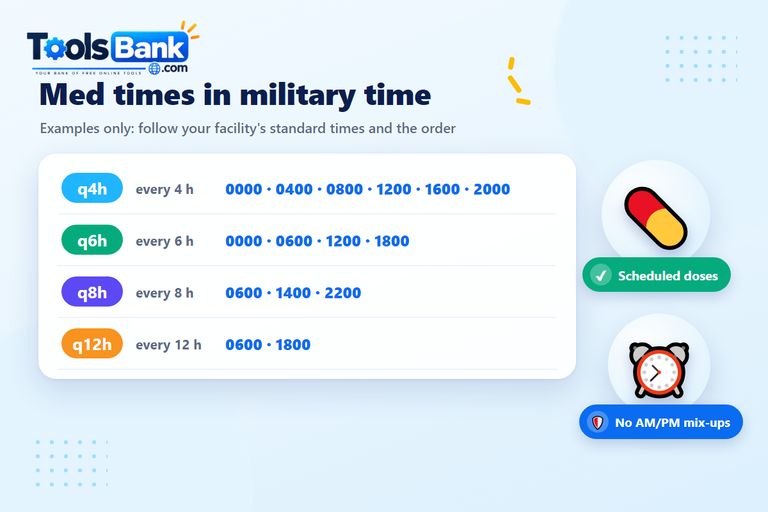
Frequency orders like q6h (every 6 hours) are easiest to schedule in military time, because the times never need AM or PM. These are examples only: every facility sets its own standard administration times, so always use your facility's schedule and the order as written.
| Order | Meaning | Example times |
| q4h | Every 4 hours | 0000, 0400, 0800, 1200, 1600, 2000 |
| q6h | Every 6 hours | 0000, 0600, 1200, 1800 |
| q8h | Every 8 hours | 0600, 1400, 2200 |
| q12h | Every 12 hours | 0600, 1800 |
Working out time between two entries
To find the time between two charted times, subtract them. If the second time is after midnight, add 24 hours to it first. Example: a dose at 2245 and the next at 0315 is 3:15 + 24:00 = 27:15, minus 22:45 = 4 hours 30 minutes.
• 0700 to 1900: 12 hours
• 2300 to 0730: 8 hours 30 minutes
• 1430 to 1815: 3 hours 45 minutes
The Time Duration Calculator does this for you, including times that cross midnight.
Common mistakes (and how to avoid them)
• Forgetting the leading zero: 830 can be misread; write 0830.
• Adding 12 to morning times: only PM hours from 1 PM onward get +12. 10:00 AM stays 1000.
• Getting noon and midnight backwards: noon is 1200, midnight is 0000.
• Late entries without a clear time: chart the time the entry is made and the time of the event, as your facility's late-entry policy requires.
• Mixing formats in one chart: don't switch between 2:30 PM and 1430. Use 24-hour time throughout.
General information only. Always follow your facility's documentation and medication-administration policies and the orders as written.
Need to convert a time quickly? Use the Military Time Converter, which shows the military, standard and spoken versions of any time.